I think it’s worth starting a written piece on the topic of ChatGPT by stating that while it’s a profound technology and deceptively “intelligent” in its ability to converse with such a human feel the chatbot that performs this impressive feat has not got a bloody clue what you’re on about……. Although the LLM (GPT) might but that’s a topic for another time.
Here’s an example
:
Tbf, ChatGPT did caveat its response with “This is just a hypothetical example, and the actual values will depend on the specific characteristics of the ball….” And the answer seems so believable until you start to think about the actual numbers that are being proposed and realise that they are a complete fabrication. So let’s add some reality to our question.
“Huh? Even if we were to take the first answer as an ‘artificial academic guess,’ we’d expect an improved version when we add some details. And herein lies the word of warning: ChatGPT predicts context,it doesn’t provide truth (Why Does AI Lie, and What Can We Do About It?, 2022).
CHatGpt for learning
So with that out of the way let’s look at how ChatGPT can be useful for learning starting with something that many students struggle with – reflection on an iterative process. For learning reflection is a powerful tool to understand what we have learned and how to measure this knowledge. However, expressing this in written form can be challenging as such a process is mostly undertaken by simply experimenting and building each step on the previous one.
Here’s where ChatGPT can be useful as a tool for suggesting ways that such experiences can expressed in text.
This paragraph can now be fleshed out with more details and analysis e.g., how did the randomisation add depth and add more realism to the footsteps? Although the AI text suggestion is mostly description it has provided us with statements we can answer and that might not have been apparent by just considering the experience in thought. For instance, what were the details of the process, were some results discarded and if so, why? What new skills were learned in the process, etc? All those parameters can now be fairly easily added to this suggested paragraph framework and this will add the depth and evaluation a reflection should have.
ChatGPT can be incredibly useful as an assistive tool and the ability to transform text while keeping its meaning can be very helpful in both trying to understand a concept and also in suggesting alternative ways to express ideas around a topic (Kirk, 2023).
technical topics
For technical subjects like coding this capacity to help correct and suggest new approaches to solutions can help beginners understand a systematic process faster as they’re actively taking part in the exercises. Take an example of writing correct syntax:
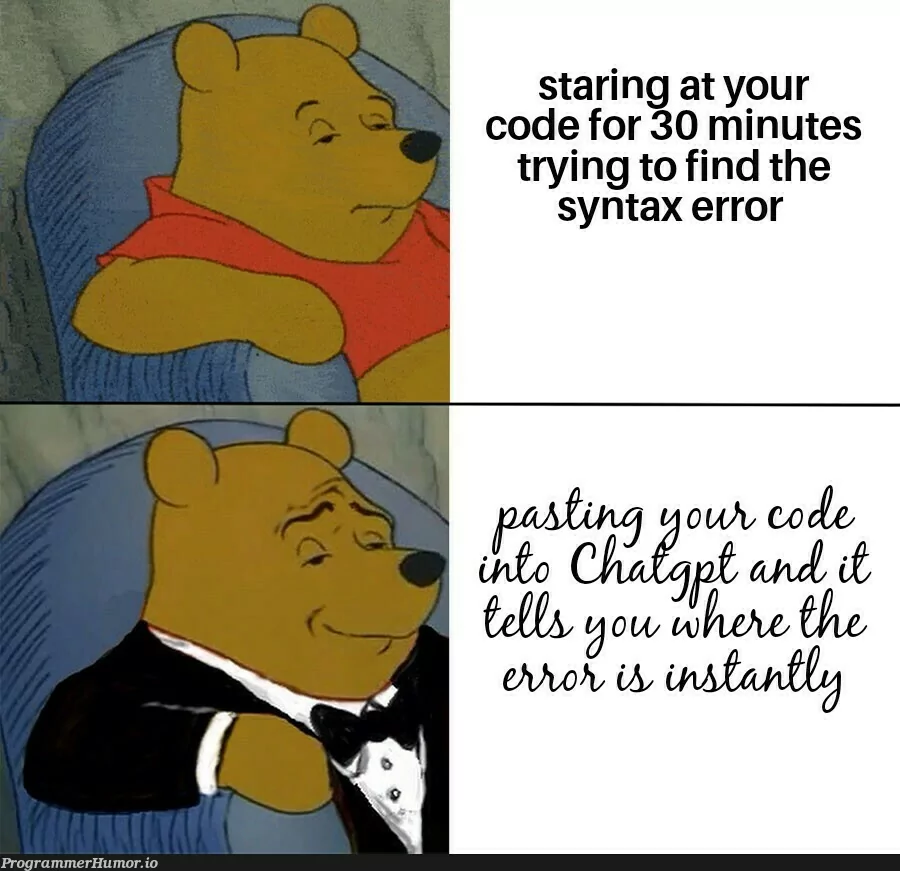
Misunderstanding syntax can often be an initial hurdle that discourages learning how coding and languages work. In this example, the initially suggested type is not going to work but by running this through ChatGPT we get some clues of what we’ve done wrong and a suggestion of how to fix the problem.
(I’ve wasted so much time…, 2023)
The educational return (no pun intended) is almost unbeatable as even if a student simply asks for the rest of the method to be written out they will learn from that result and as coding is so much about remembering the syntax form there’s still value in doing this. A better educational value would of course be to try and figure out what to do when player health is == 0 but since ChatGPT so often produces code that doesn’t work students will need to learn how to think multilaterally and come up with their own creative solutions anyway.
in summary
ChatGPTs ability to suggest and transform text without losing meaning can be a fantastic assistive tool in learning and helpful when reflecting on experiences in written form. However, we need to be mindful that it is terrible at providing correct answers and we should avoid using it as a source of knowledge.
To understand more about LLMs and how ChatGPT relates to GPT I highly recommend the channels of Rob Miles and Computerphile



Leave a Reply